
LiveReview
LiveReview scores every pull request for risk and auto-approves the safest 30-50%, so senior engineers only review changes that carry real risk. Free and self-hostable.
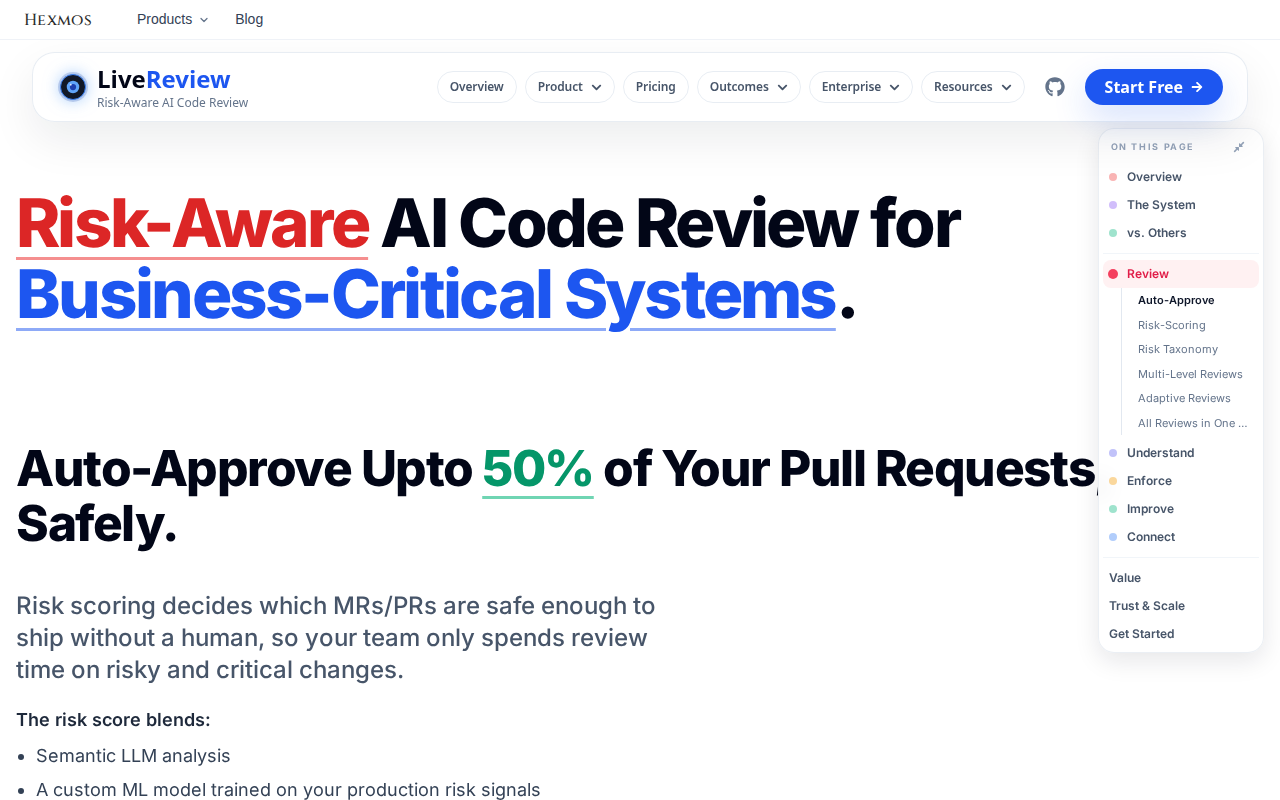
LiveReview Review: Risk-Aware AI Code Review That Auto-Approves Safe Pull Requests
AI now writes a large share of new code, but code review has not kept up. Every pull request still waits in the same queue for the same few senior engineers, whether it renames a variable or rewrites a payment flow. Seniors become the bottleneck, they skim, and the risky changes are the ones that slip into production.
LiveReview takes a different approach: instead of adding more comments to a thread, it scores every pull request for risk, auto-approves the safest 30–50%, and sends the risky ones to the right human reviewers. The result it promises is measured in production outcomes — fewer incidents, fewer rollbacks, and less senior reviewer time.
What is LiveReview?
LiveReview is a risk-aware AI code review tool for business-critical systems, built by Hexmos, the team behind git-lrc. It combines semantic LLM analysis, a custom machine-learning model trained on production risk signals, and static graph-based analysis of your codebase to produce a risk score for every change. Low-risk changes ship immediately; high-risk changes get prioritized review with comments sorted by blast radius.
The approach is inspired by Meta's internal AI review system, RADAR. At Meta, risk-based review was reported to deliver 50× fewer production incidents, 3× fewer rollbacks, and 35% faster reviews. LiveReview brings the same idea to any team, and it is free and self-hostable.
Key Features
1. Risk scoring for every pull request
Each change gets a risk score built from three signals: what the code does (semantic LLM analysis), what production history says (an ML model trained on your incident and rollback signals), and how far the change can reach (a live call graph of your codebase). A 3-line fix in a function used by 40 files scores high; a 300-line UI change used by nothing scores low.
2. Auto-approve for the safest changes
The lowest-risk 30–50% of pull requests are approved instantly, under a conservative, balanced, or aggressive policy you choose. Per-repository and per-path rules let you tune the policy, force-approve with a recorded reason when needed, and every approval decision is explained on the PR itself.
3. Review Priority ranking
Within a risky PR, LiveReview ranks every hunk by how much scrutiny it deserves — logic complexity, nesting depth, fan-out, and whether the code has tests. Reviewers see the most dangerous parts first instead of reading a diff top to bottom.
4. Cognitive Coverage
AI-written code is only safe if your team still understands it. Cognitive Coverage walks through a PR as slides or a summary, or quizzes you on it before it merges, so the team keeps intellectual control of the codebase even as generative AI writes more of it.
5. Livi Assistant and analytics
Ask about your engineering data in plain English — on the web or in Slack, Teams, and Discord. Livi tracks adoption, ROI, incidents, false approvals, and overrides across 50+ actionable graphs, and feeds what it learns back into the review policy.
How It Works
Connect LiveReview to your repository on GitHub, GitLab, Bitbucket, Gitea, or Azure DevOps, and bring your own Claude or OpenAI key — or use any of 15+ AI providers, or the LiveReview model. When a pull request opens, LiveReview analyzes the diff against your codebase's call graph, traces past incidents and rollbacks back to the commits behind them, and assigns a risk score. Safe changes are auto-approved; risky ones are routed to human reviewers with the riskiest hunks on top. You can try a policy on past PRs first, then tighten or loosen it as real data comes in.
Who Should Use LiveReview?
- Engineering teams shipping AI-written code: Keep review quality high while AI increases code volume.
- Senior engineers and tech leads: Spend review time only on changes that carry real business risk.
- Teams running business-critical systems: Payment, infrastructure, and core-product code where a bad merge is expensive.
- Platform and DevOps teams: Enforce review standards per team and repository, with audit trails.
- Open-source maintainers: Triage a flood of contributions by risk instead of reading every diff in order.
Pricing
LiveReview is free and self-hostable — run it on your own infrastructure. You bring the AI model: reuse the Claude or OpenAI key you already pay for, connect any of 15+ supported providers, or use the LiveReview model. There is no per-seat charge stated for the self-hosted version.
LiveReview Pros and Cons
Pros
- Auto-approves the safest 30–50% of PRs, cutting review queues.
- Risk scoring is explainable, not a black box — every factor is visible.
- Learns from production incidents, rollbacks, and overrides.
- Free and self-hostable; works with the model key you already have.
- Supports GitHub, GitLab, Bitbucket, Gitea, and Azure DevOps.
Cons
- Risk models need production history to be at their best; new repos start with less signal.
- Teams must actively calibrate the auto-approve policy — the default is only a starting point.
- Most valuable for teams with real review bottlenecks; small teams may not feel the difference.
Final Verdict
Most AI review tools add more comments to the thread. LiveReview changes what gets reviewed at all. If your seniors are the bottleneck and AI is writing more of your code, risk-scored review with safe auto-approval is the most direct fix — and the fact that it is free and self-hostable makes it easy to try on your own repositories.


