Plurai Simulation
Plurai Simulation builds a digital twin of your AI agent and tests it in a simulated world, finding failures with verified fixes before your users do. Launched on Product Hunt on November 12, 2026 as the number one product of the day.
Plurai Simulation Review: Find Where Your AI Agent Breaks Before Your Users Do
Most AI agent testing grades the chat transcript. The transcript says the refund was issued, the booking was changed, the ticket was filed. But did the refund actually happen? Did the booking change in the real system, or did the agent just write a confident sentence about it? That gap is where production agents fail quietly, and it is exactly the gap Plurai Simulation was built to close.
Plurai Simulation launched on Product Hunt on November 12, 2026 and took the number one spot of the day with 357 upvotes. It comes from Plurai, a team whose founder previously built simulation for autonomous driving, where cars earn trust over millions of simulated miles before they ever touch a real road. Plurai applies the same idea to AI agents: let your agent practise in a simulated world, find its worst failures there, and fix them before your users ever meet them.
What Is Plurai Simulation?
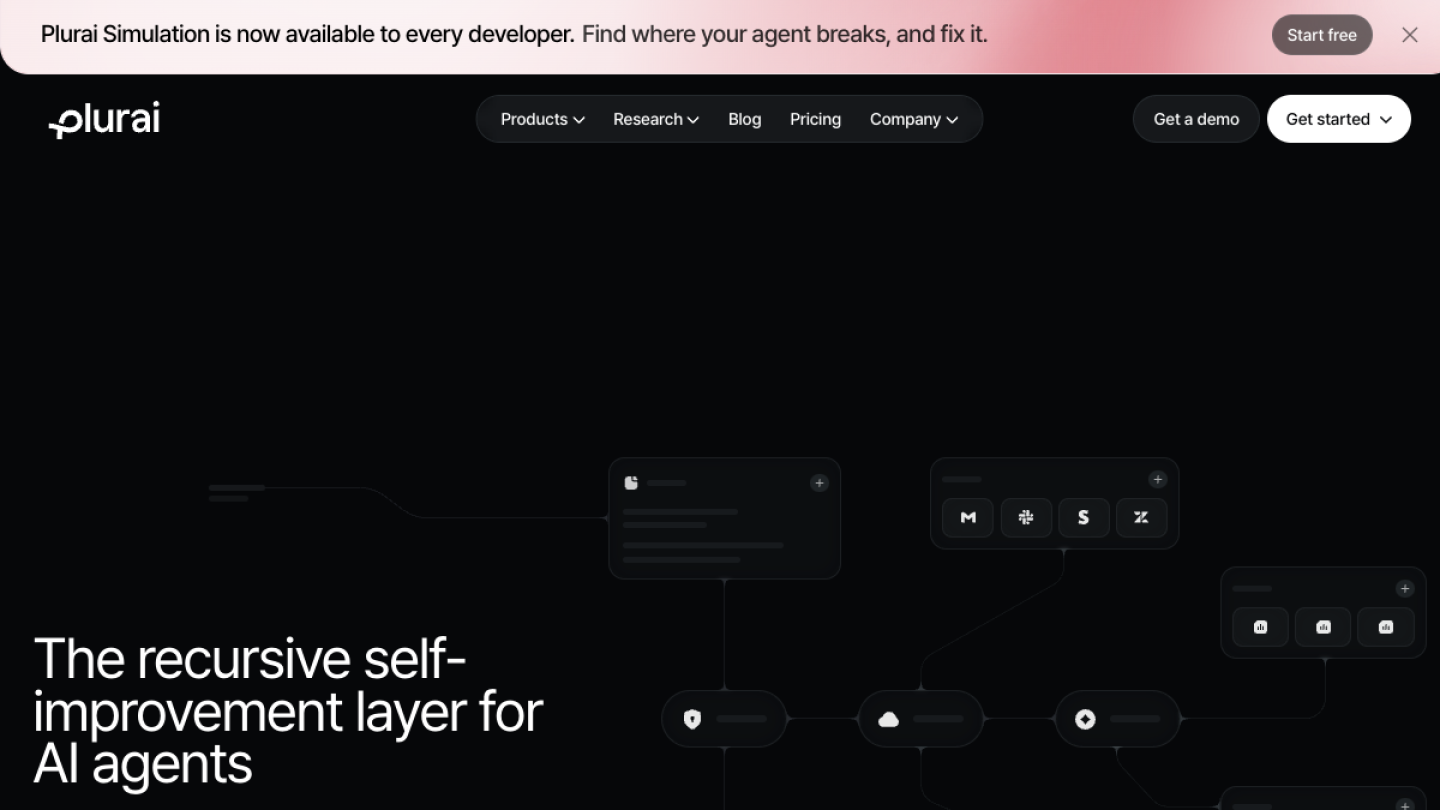
Plurai Simulation is the simulation half of Plurai, a platform that describes itself as the recursive self-improvement layer for AI agents. The idea is a loop: Simulation finds where your agent breaks and how to fix it, post-training makes the agent better and cheaper, and every run feeds the next. Simulation is the part that launched on Product Hunt, and it is available to every developer now.
Here is how it works in practice. Plurai reads your agent as it is built and wires it into a simulated world, a digital twin of the agent and everything around it. The tools it calls, the sub-agents it delegates to and the knowledge it grounds on are rebuilt from your code, with one consistent world state. Your agent then runs its real tasks, workflows and conversations inside that world, in sandboxes that never touch production. Difficult personas push back on every flow, from simple to brutal, and automatic evaluations check what the agent actually did to the world, not what it said in the chat.
Key Features of Plurai Simulation
1. A digital twin of your agent, built from your code
Plurai maps your agent as built, then mocks the world around it: the tools it calls, the sub-agents it delegates to and the knowledge base it grounds on. What should be mocked is mocked, and what matters stays live, like your retrieval system. You point Plurai at your repository from inside the coding agent you already use, and one command builds the twin. Later runs reuse it, and you only rewire it after a major change to the agent.
2. Personas that push back on every flow
Instead of a polite fake user, Plurai sends in synthetic personas that walk every flow, simple to brutal. They argue, change their minds, give incomplete information and try the edge cases a real user would find on a bad day. Plurai says this gives 15 times the production edge-case coverage of hand-written tests, because the scenarios come from the agent's real behaviour rather than from a list somebody guessed in advance.
3. Evaluations that check what the agent did, not what it said
Traditional agent testing grades the conversation. Plurai grades the world state: was the refund really issued, the booking really changed, the record really updated? Each scenario is played several times to check that the agent behaves consistently, and every evaluation is scored against what happened, not against how convincing the reply sounded.
4. Every failure arrives with a fix that is verified before it ships
When Simulation finds a failure, it does not just file a report. Each bug comes back with the conversation that proves it and a fix, delivered in the coding agent you already use, and the fix is re-run three times before it counts as verified. According to the Plurai team, teams using Simulation cut their agent failure rates by 82 percent.
5. Production failures replay from the exact step that broke
When something goes wrong in production, Plurai replays the failure from the exact step it broke, even after your agent has changed since then. That turns a vague user complaint into a reproducible case you can fix and then prove fixed, instead of a bug you can never reproduce on your own machine.
How It Works
Getting started takes one command in Claude Code, Codex or GitHub Copilot, or you can connect through the Simulation connect page and start free. Plurai reads your agent from your repository and wires its digital twin, then you run your scenarios. A run is one full pass of your scenarios against your agent, with every evaluation scored, and each scenario is played several times to check consistency. Failures come back with proof and a fix, the fix is verified by re-running it, and the improved agent goes back into the loop. The second half of the platform, post-training, then turns what Simulation learned into a smaller, cheaper model of your own, with 44 times lower cost than Claude Haiku-5.5 and 10 percent higher accuracy, according to Plurai.
Who Should Use Plurai Simulation?
- Teams shipping customer-facing agents: support, travel, finance or operations agents where a wrong action costs real money or trust.
- Developers whose agents call real tools: if your agent books, refunds, files or updates records, you need to know it did the thing, not just said it did.
- Teams replacing hand-written evals: if your test list is a guess at what users might do, Simulation generates the hard cases from the agent itself.
- Companies that want to own their intelligence: Simulation plus post-training is built for teams that want their own model, tuned on their own failures, instead of renting one.
- Regulated or high-stakes products: where an agent mistake becomes a compliance problem, reproducible proof of a fix is worth more than a passing test.
Pricing
Simulation starts free. The Free plan costs 0 dollars and includes a one-time allowance of 12,300 credits, 2 agent setups, 7 scenarios, 3 runs and 10 sandbox hours, with no overage and never a charge. The Base plan costs 60 dollars per month and includes 28,710 credits every month, 3 agent setups, 14 scenarios, 20 runs per month, 20 traces analysed per month and 30 sandbox hours, with pay-as-you-go overage at 0.02 dollars per credit. The Business plan costs 210 dollars per month and includes 65,570 credits every month, 28 scenarios, 60 runs per month, 40 traces analysed and 100 sandbox hours, with overage at 0.015 dollars per credit. Members are free on every plan, and you can cancel any time by switching back to Free. Plurai also sells its small evaluation model separately, starting with a Starter tier that includes 1 million free tokens and one dedicated personal endpoint, and an Enterprise tier with on-premises deployment, enterprise single sign-on, a custom service agreement and white-glove service.
Pros and Cons
Pros
- Tests what the agent did to the world, not what it said, which is the failure mode that actually hurts in production.
- Every failure ships with a verified fix, re-run three times, instead of a report you have to interpret yourself.
- Production failures replay from the exact breaking step, even after the agent changed.
- Starts free with a real allowance, and members cost nothing on every plan.
- The loop continues into post-training, with large claimed savings on inference cost.
- Independently verified for SOC compliance, and built on NVIDIA infrastructure.
Cons
- Credit-based pricing takes care to budget: long, chatty agents burn more Sim credits and sandbox hours than short ones.
- It is built for teams with real agents in code; if your agent is a simple prompt with no tools, most of this power is unnecessary.
- The biggest claimed numbers, like the 82 percent failure-rate cut, come from the Plurai team itself rather than from independent benchmarks.
- Post-training is a second product with its own pricing, so the full loop costs more than Simulation alone.
Final Verdict
Plurai Simulation is the most convincing answer yet to the hardest question in agent development: how do you know your agent works before your users find out it does not? By rebuilding your agent's world, letting difficult personas loose in it, grading what actually happened and handing you a verified fix, it turns agent testing from a transcript review into engineering. The free tier is generous enough to try on a real agent, and the 82 percent failure-rate reduction the team reports is exactly the kind of result that pays for the 60 dollar Base plan many times over. If you ship agents that touch real systems, Simulation belongs in your workflow before your next launch, not after your next incident.
FAQ
Frequently asked questions
What is Plurai Simulation?
Plurai Simulation builds a digital twin of your AI agent and tests it in a simulated world, finding failures with verified fixes before your users do.