ProtoMap
ProtoMap by HoundDog.ai is a context engine for gRPC and Protobuf that scans your source code and gives engineers and coding agents an org-wide map of services, callers and field-level dataflows, free to self-host.
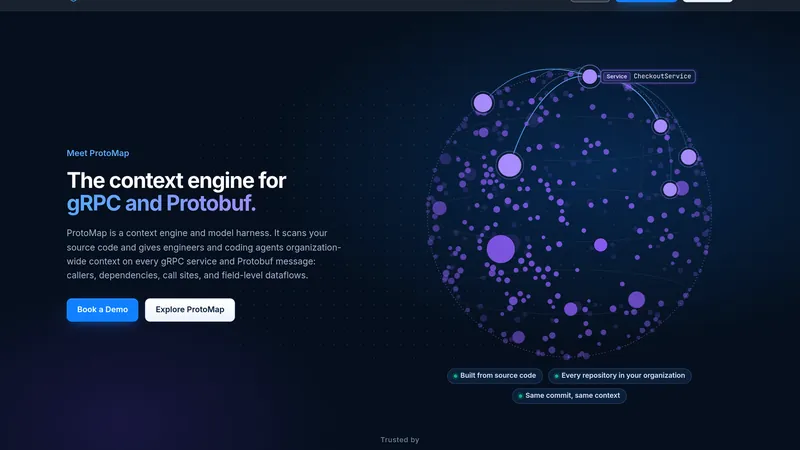
ProtoMap Review: Give Your Coding Agents the Full gRPC Map Before They Change Anything
AI coding agents are fast at editing code and slow at understanding it. Ask one to remove a gRPC method or rename a Protobuf field, and it burns tokens grepping across repositories, writing throwaway scripts to trace callers, and still misses the services it cannot see. ProtoMap exists to end that waste: a precomputed, deterministic map of every service, API and field in your organization.
ProtoMap by HoundDog.ai launched on Product Hunt on November 9, 2026, finishing #5 of the day. It is a context engine and model harness for gRPC and Protobuf that gives engineers and coding agents the same org-wide context before any change is made.
What is ProtoMap?
ProtoMap scans your source code with a deterministic Rust scanner and builds a living graph of your services: which services call which methods, which fields flow where, and what breaks if something changes. Engineers query the graph in plain English through the web platform; coding agents query it over MCP instead of grepping across repositories they cannot see.
The graph refreshes on every commit in CI, on standard CPU infrastructure, so the context your agents use always matches the code as it is now. The self-hosted version is free, runs on your machine with Docker, and your source code never leaves your environment.
Key Features
1. Deterministic Service Graph
A Rust scanner builds the graph from source code, not from model guesses, so the map is exact and reproducible. It covers monorepos and microservices alike, refreshed on every commit.
2. Blast-Radius Analysis
Before changing a method or field, see every caller, every dependency and every call site across the organization, including repositories your agent has never checked out.
3. MCP for Coding Agents
ProtoMap exposes the graph over MCP to Claude Code, Codex, Antigravity and other agents, so they ask the map instead of re-discovering dependencies with expensive searches.
4. Free Self-Hosted Install
Install the server with Docker, scan a repository, and query it in plain English. Your code stays in your environment, and the trial runs PostgreSQL locally with a one-time setup key.
5. Benchmarked Token Savings
In HoundDog's benchmark, Claude Code with Opus 5.5 answered change-planning questions with 13x fewer tokens, 7.7x faster and 6.4x cheaper per prompt when using ProtoMap, at higher accuracy (100% vs 98%), across 9 gRPC repositories with 5 million lines of code.
How It Works
Install ProtoMap Server outside your repository, run the installer, and scan your code with the CLI. The scanner builds the service graph into a local database, and the web UI lets you explore services, callers and dataflows. Add ProtoMap as an MCP server to your coding agent, and it can answer questions such as which services call a method and where, using the same graph you see.
Who Should Use ProtoMap?
- Platform teams: Give every engineer and agent one shared map of the service landscape.
- Backend teams on gRPC: Change APIs safely by seeing the full blast radius first.
- AI-assisted development teams: Cut the tokens agents waste rediscovering dependencies.
- Enterprises with monorepos: Keep context accurate across millions of lines and many teams.
- Microservices organizations: Trace field-level dataflows across services you do not own.
Pricing
ProtoMap is free to self-host on one machine: install the server with Docker and scan your repositories at no cost. Cloud and on-premises options are available for organizations that want managed hosting or wider deployment. HoundDog does not publish list prices for those plans, so teams should contact them for a quote.
ProtoMap Pros and Cons
Pros
- Deterministic graph, not model guesswork: the map is exact and reproducible.
- Free self-hosted version keeps your code inside your own environment.
- Large measured token and time savings for agent-assisted change planning.
- MCP integration works with the coding agents teams already use.
Cons
- Built for gRPC and Protobuf only; it adds little for REST-only codebases.
- Self-hosting needs Docker with Compose 2.23.1 or newer, at least 4 GB of RAM and 20 GB of disk.
- The headline benchmark figures come from HoundDog's own tests and vary by model, repository and task.
- Full value requires scanning every repository, not just one.
Final Verdict
ProtoMap solves a problem every team with AI coding agents is already paying for in tokens and broken changes: agents that cannot see the whole system. A deterministic, always-fresh map of your gRPC services is a better answer than another round of grep.
If your services speak gRPC and your agents keep rediscovering the same dependencies, install the free self-hosted version and let the map do the searching.
FAQ
Frequently asked questions
What is ProtoMap?
ProtoMap is a AI tool listed on aifly.tools that adds new capabilities to your AI coding agent. See the description and screenshots above for what it does.
How do I install ProtoMap?
Click the Visit button below to open the official website and sign up there.
Is ProtoMap free?
Yes — ProtoMap is free to install. Some skills may still need an API key for the underlying service they call.
How do I update ProtoMap?
Open the official website with the Visit button below and check for the latest version there.